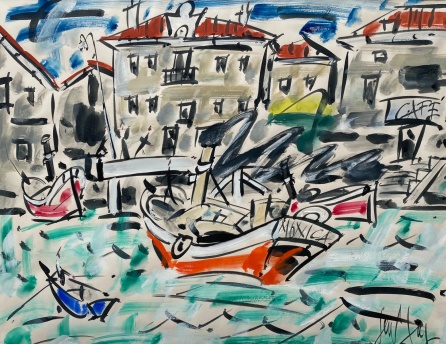
Watercolour & Gouache on Paper
Signed
Size (inches) : 19 (h) x 25.5 (w)
Size (cm) : 48.26 (h) x 64.77 (w)
Frame Size (inches) : 26.5 (h) x 33 (w)
Frame Size (cm) : 67.31 (h) x 83.82 (w)
View on background colour: Dark Graphite
string(6) "string"
string(2169) "
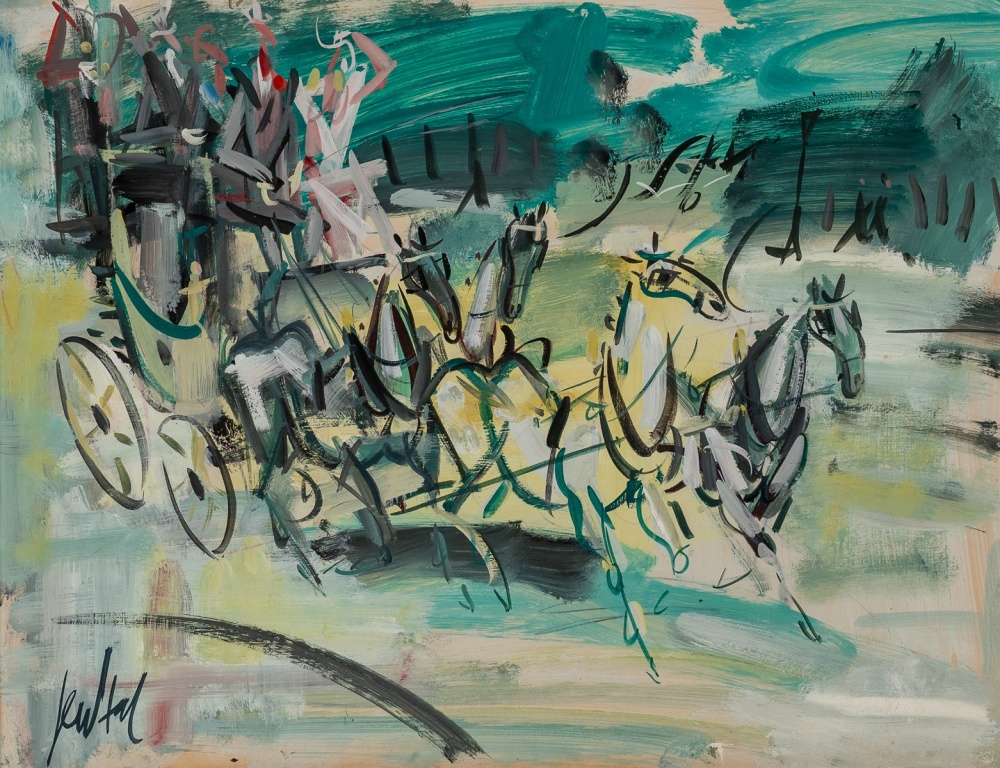
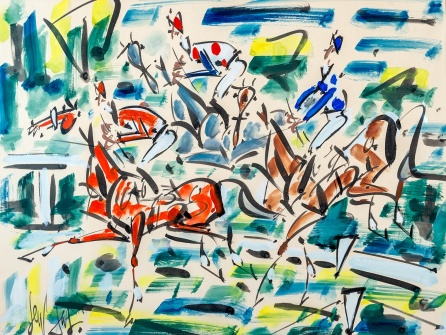
The Promenade bursts with dynamic energy, capturing the speed and vitality of a horse-drawn carriage in motion. Paul uses expressive, gestural brushstrokes and a vivid, high-contrast palette dominated by turquoise, teal, black, and warm yellow tones. The central focus is the carriage and its four galloping horses. Rather than precise anatomical rendering, Paul distills them into a sequence of fluid lines, angular shapes, and sweeping arcs, conveying motion more than form. The carriage’s wheels are mere suggestions - circles of loosely painted lines, emphasising movement over stability.
The figures atop the carriage are abstracted, their postures and arm movements giving a sense of bustling conversation and excitement. Splashes of red among muted greys and pinks add a lively human presence without detailing individual identities.
The background is kept loose and impressionistic: broad horizontal swaths of teal and green hint at open countryside or parkland, while vertical marks suggest fencing or distant trees. The ground is rendered with rapid, curved strokes that mirror the forward thrust of the horses, heightening the sensation of speed. Overall, the painting conveys motion, rhythm, and spontaneity, almost like a jazz improvisation in visual form.
Paul’s style is characterised by loose, calligraphic brushwork that emphasises gesture over detail. Vivid, non-naturalistic colour choices to heighten emotional impact. A rhythmic arrangement of forms that suggests music and movement.
In The Promenade, Paul departs from static realism, focusing instead on the sensation of a passing moment - the wind, the hooves striking the ground, the carriage swaying. This approach reflects the broader modernist interest in speed and motion seen in early 20th-century art movements like Futurism, but retains a more lyrical, painterly sensibility.
The title The Promenade feels somewhat ironic - traditionally suggesting a leisurely stroll, but here, the scene is anything but slow. Instead, it’s a celebration of life in motion, rendered in sweeping strokes that capture the fleeting energy of urban and rural life alike.
"
The Promenade bursts with dynamic energy, capturing the speed and vitality of a horse-drawn carriage in motion. Paul uses expressive, gestural brushstrokes and a vivid, high-contrast palette dominated by turquoise, teal, black, and warm yellow tones. The central focus is the carriage and its four galloping horses. Rather than precise anatomical rendering, Paul distills them into a sequence of fluid lines, angular shapes, and sweeping arcs, conveying motion more than form. The carriage’s wheels are mere suggestions - circles of loosely painted lines, emphasising movement over stability.
The figures atop the carriage are abstracted, their postures and arm movements giving a sense of bustling conversation and excitement. Splashes of red among muted greys and pinks add a lively human presence without detailing individual identities.
The background is kept loose and impressionistic: broad horizontal swaths of teal and green hint at open countryside or parkland, while vertical marks suggest fencing or distant trees. The ground is rendered with rapid, curved strokes that mirror the forward thrust of the horses, heightening the sensation of speed. Overall, the painting conveys motion, rhythm, and spontaneity, almost like a jazz improvisation in visual form.
Paul’s style is characterised by loose, calligraphic brushwork that emphasises gesture over detail. Vivid, non-naturalistic colour choices to heighten emotional impact. A rhythmic arrangement of forms that suggests music and movement.
In The Promenade, Paul departs from static realism, focusing instead on the sensation of a passing moment - the wind, the hooves striking the ground, the carriage swaying. This approach reflects the broader modernist interest in speed and motion seen in early 20th-century art movements like Futurism, but retains a more lyrical, painterly sensibility.
The title The Promenade feels somewhat ironic - traditionally suggesting a leisurely stroll, but here, the scene is anything but slow. Instead, it’s a celebration of life in motion, rendered in sweeping strokes that capture the fleeting energy of urban and rural life alike.