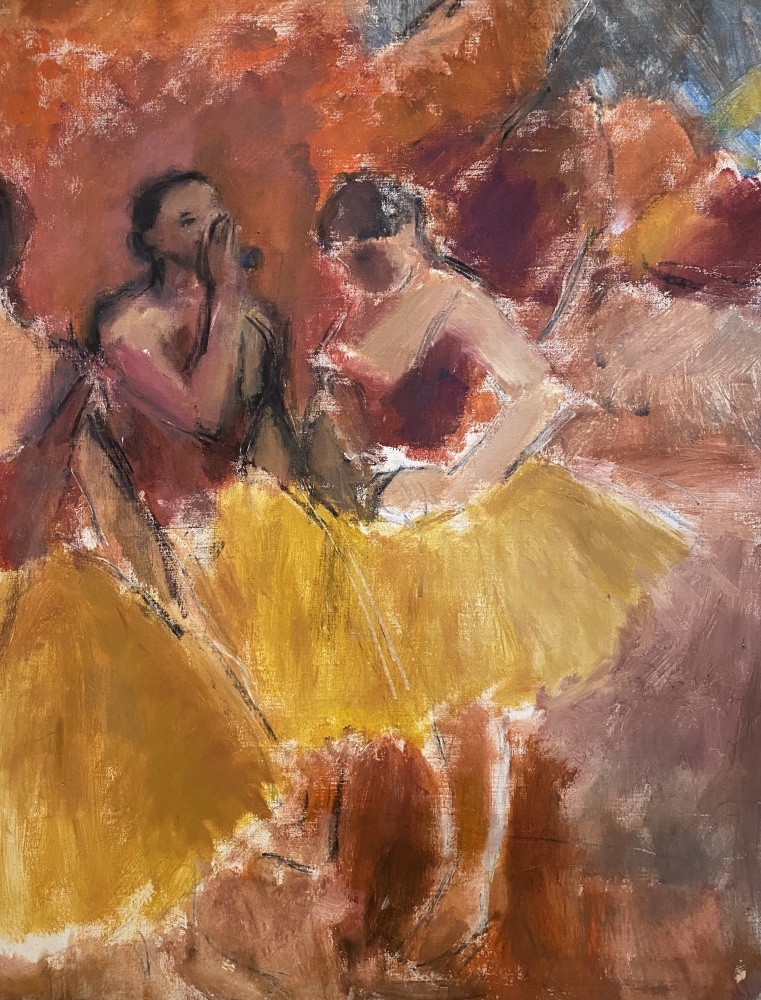
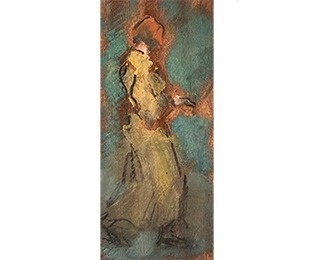
In Dancers after Degas, Ghislaine Howard pays homage to the celebrated ballet scenes of Edgar Degas while reinterpreting them through her own expressive and contemporary language. Swathed in glowing ochres, warm reds, and luminous pinks, the dancers emerge through energetic brushwork and fluid, unfinished forms that evoke movement, rehearsal, and fleeting human interaction.
Howard captures not the polished perfection of performance, but the intimacy and spontaneity that fascinated Degas himself. The figures appear caught mid-conversation or preparation, their bodies loosely defined yet full of vitality and grace. Brilliant yellow skirts flare against the rich, atmospheric background, creating a dramatic interplay of colour and rhythm across the composition.
The painting balances elegance with raw immediacy. Gestural lines and layered paint lend the work a sense of motion and emotional warmth, while the partially abstracted forms encourage the viewer to focus on atmosphere rather than detail. Howard transforms the familiar subject of the ballet dancer into something deeply personal and contemporary; a study of movement, femininity, and human presence. Dancers after Degas is both a tribute to art history and a vibrant celebration of paint itself.
"
In Dancers after Degas, Ghislaine Howard pays homage to the celebrated ballet scenes of Edgar Degas while reinterpreting them through her own expressive and contemporary language. Swathed in glowing ochres, warm reds, and luminous pinks, the dancers emerge through energetic brushwork and fluid, unfinished forms that evoke movement, rehearsal, and fleeting human interaction.
Howard captures not the polished perfection of performance, but the intimacy and spontaneity that fascinated Degas himself. The figures appear caught mid-conversation or preparation, their bodies loosely defined yet full of vitality and grace. Brilliant yellow skirts flare against the rich, atmospheric background, creating a dramatic interplay of colour and rhythm across the composition.
The painting balances elegance with raw immediacy. Gestural lines and layered paint lend the work a sense of motion and emotional warmth, while the partially abstracted forms encourage the viewer to focus on atmosphere rather than detail. Howard transforms the familiar subject of the ballet dancer into something deeply personal and contemporary; a study of movement, femininity, and human presence. Dancers after Degas is both a tribute to art history and a vibrant celebration of paint itself.