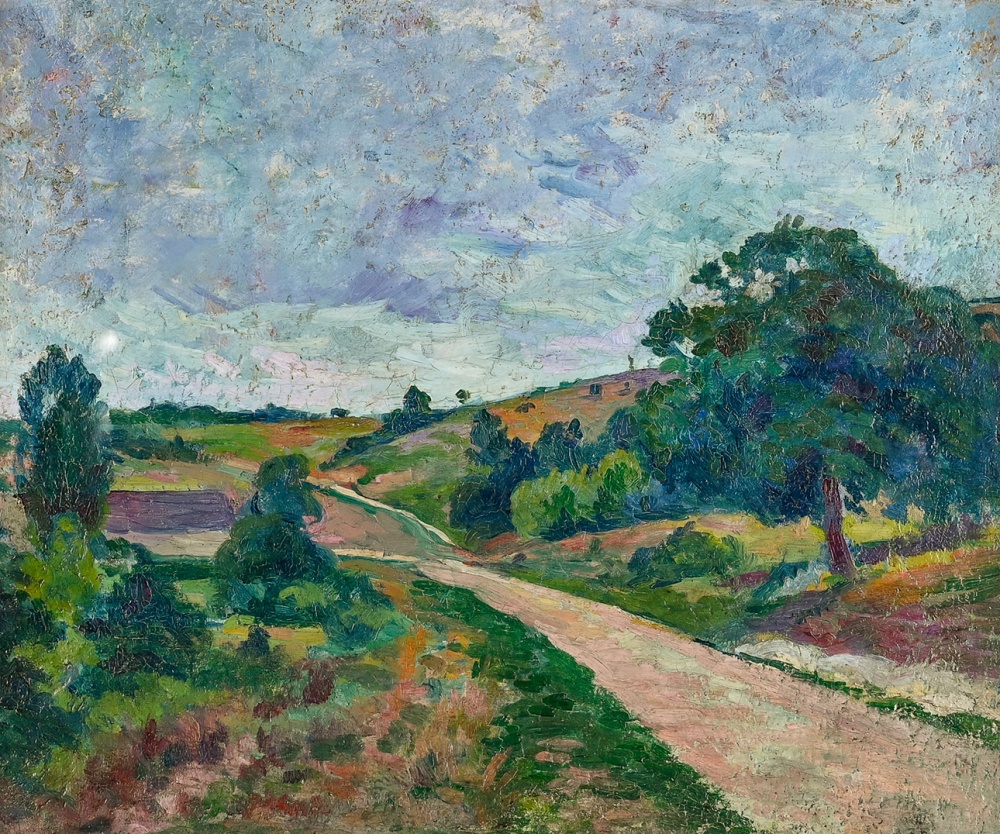
Afternoon Provence, South of France
Signed
Size (inches) : 15 (h) x 18 (w)
Size (cm) : 38.1 (h) x 45.72 (w)
Frame Size (inches) : 22.5 (h) x 25.5 (w)
Frame Size (cm) : 57.15 (h) x 64.77 (w)
View on background colour: Dark Graphite
Afternoon Provence, South of France
string(6) "string"
string(1838) "
Afternoon Provence is a luminous landscape painted with the vibrant, broken brushstrokes characteristic of Post-Impressionism and Divisionism. The composition centres on a winding dirt road leading the viewer's gaze into the rolling hills of Provence. The foreground is alive with earthy pinks, warm ochres, and lush greens, creating a tactile sense of the dusty rural path bordered by bushes and grass. On either side of the road, trees rendered in deep emerald, cobalt, and touches of violet rise against the open countryside, their foliage suggested through quick, energetic strokes. The middle ground features undulating hills bathed in soft sunlight, dotted with sparse, dark green trees. The warm, golden tones of the fields suggest the dry Mediterranean climate in late afternoon. The sky, which occupies nearly half the canvas, is animated with a complex interplay of pale blues, lilacs, and whites, applied in a mosaic-like manner. The brushwork here conveys a breezy, almost shimmering quality to the light, a hallmark of Luce’s technique. Overall, the painting captures a sense of tranquil warmth and timeless rural beauty, evoking the languid atmosphere of a Provençal summer afternoon.
Luce painted landscapes, urban scenes, and working-class subjects, often imbuing his work with both technical innovation and social awareness. In the 1890s, he traveled extensively in France, producing a number of vivid landscapes of Normandy, Brittany, and the south of France - including Provence.
Afternoon Provence reflects Luce’s fascination with light and atmosphere, translating the unique colours of the region into his Divisionist palette. While clearly influenced by Seurat’s optical colour mixing, this work shows Luce moving toward a more fluid, painterly style that would dominate his later years.
"
Afternoon Provence is a luminous landscape painted with the vibrant, broken brushstrokes characteristic of Post-Impressionism and Divisionism. The composition centres on a winding dirt road leading the viewer's gaze into the rolling hills of Provence. The foreground is alive with earthy pinks, warm ochres, and lush greens, creating a tactile sense of the dusty rural path bordered by bushes and grass. On either side of the road, trees rendered in deep emerald, cobalt, and touches of violet rise against the open countryside, their foliage suggested through quick, energetic strokes. The middle ground features undulating hills bathed in soft sunlight, dotted with sparse, dark green trees. The warm, golden tones of the fields suggest the dry Mediterranean climate in late afternoon. The sky, which occupies nearly half the canvas, is animated with a complex interplay of pale blues, lilacs, and whites, applied in a mosaic-like manner. The brushwork here conveys a breezy, almost shimmering quality to the light, a hallmark of Luce’s technique. Overall, the painting captures a sense of tranquil warmth and timeless rural beauty, evoking the languid atmosphere of a Provençal summer afternoon.
Luce painted landscapes, urban scenes, and working-class subjects, often imbuing his work with both technical innovation and social awareness. In the 1890s, he traveled extensively in France, producing a number of vivid landscapes of Normandy, Brittany, and the south of France - including Provence.
Afternoon Provence reflects Luce’s fascination with light and atmosphere, translating the unique colours of the region into his Divisionist palette. While clearly influenced by Seurat’s optical colour mixing, this work shows Luce moving toward a more fluid, painterly style that would dominate his later years.