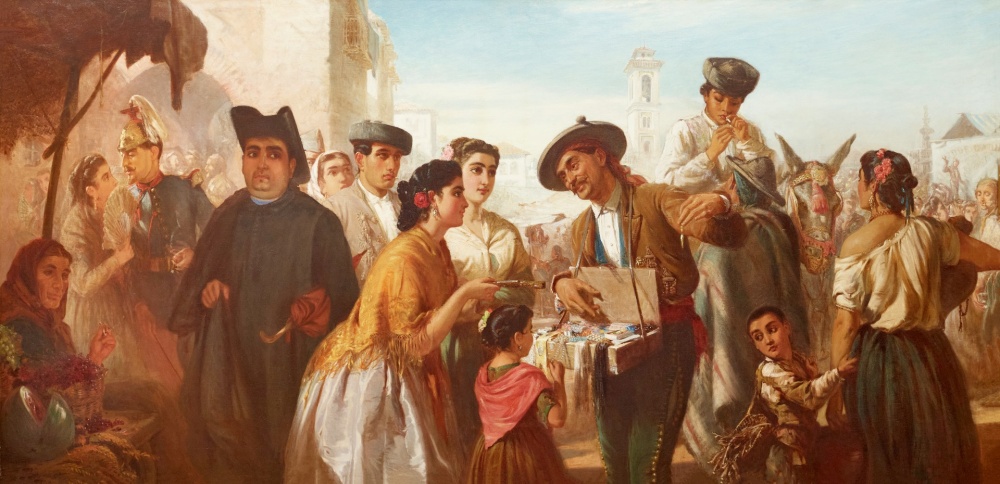
La Feria presents a bustling Spanish market scene alive with colour, movement, and human interaction. At the centre, a street vendor opens his case of trinkets and goods to an elegantly dressed young woman, draped in a golden shawl, who leans forward with curiosity while a child peers eagerly at the wares. The lively crowd surrounding them is a tapestry of characters - monks, soldiers, peasants, and townsfolk, each captured with distinct expressions and gestures, giving the painting a vivid narrative quality. In the background, sunlit architecture and the distant church tower place the scene within a quintessential Andalusian setting. A donkey, partially visible behind the vendor, further grounds the scene in rural tradition. The warm palette of ochres, reds, and earthy tones enhances the vibrancy of the composition, while the play of light across fabrics, faces, and stone architecture animates the festive atmosphere. Williams employs a realist yet theatrical style, blending sharp detail with painterly warmth. His careful observation of costume, gesture, and social types demonstrates an ethnographic interest in local traditions, while his composition; crowded yet harmonious - reflects his skill in storytelling. The balance between genre painting and romanticised spectacle situates the work within the 19th-century fascination for exoticism and the celebration of Southern European culture. La Feria is both a celebration of Spanish culture and a testament to Victorian Britain’s fascination with Mediterranean life. The work captures not only the vivid spectacle of a marketplace but also the complex interplay of class, costume, and commerce. Through its rich storytelling and painterly detail, Williams’ canvas offers both a lively ethnographic record and a romanticised vision of 19th-century Spain.
"
La Feria presents a bustling Spanish market scene alive with colour, movement, and human interaction. At the centre, a street vendor opens his case of trinkets and goods to an elegantly dressed young woman, draped in a golden shawl, who leans forward with curiosity while a child peers eagerly at the wares. The lively crowd surrounding them is a tapestry of characters - monks, soldiers, peasants, and townsfolk, each captured with distinct expressions and gestures, giving the painting a vivid narrative quality. In the background, sunlit architecture and the distant church tower place the scene within a quintessential Andalusian setting. A donkey, partially visible behind the vendor, further grounds the scene in rural tradition. The warm palette of ochres, reds, and earthy tones enhances the vibrancy of the composition, while the play of light across fabrics, faces, and stone architecture animates the festive atmosphere. Williams employs a realist yet theatrical style, blending sharp detail with painterly warmth. His careful observation of costume, gesture, and social types demonstrates an ethnographic interest in local traditions, while his composition; crowded yet harmonious - reflects his skill in storytelling. The balance between genre painting and romanticised spectacle situates the work within the 19th-century fascination for exoticism and the celebration of Southern European culture. La Feria is both a celebration of Spanish culture and a testament to Victorian Britain’s fascination with Mediterranean life. The work captures not only the vivid spectacle of a marketplace but also the complex interplay of class, costume, and commerce. Through its rich storytelling and painterly detail, Williams’ canvas offers both a lively ethnographic record and a romanticised vision of 19th-century Spain.