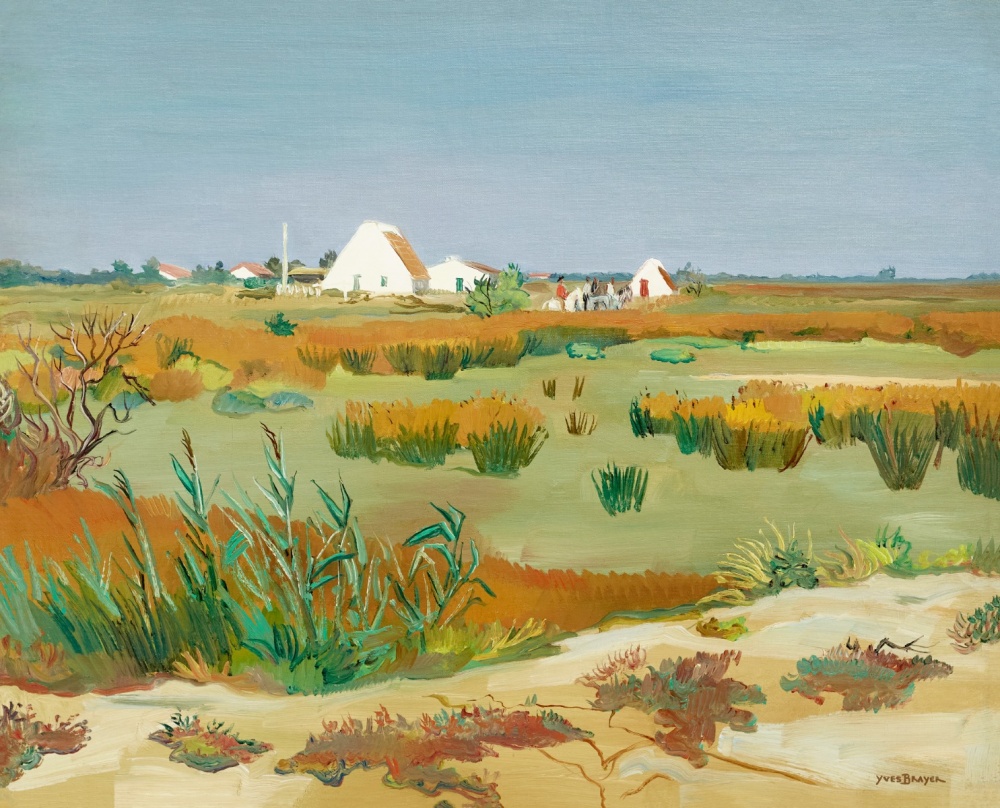
Champs Vert - or 'Green Fields' depicts an expansive pastoral scene, rolling fields of vibrant verdant hues under a bright sky. Central to the composition, a group of horses and riders traverse the meadow, suggesting rural calm and quiet movement. Brayer’s brushwork is distinctive: bold, defined strokes shape grasses and foliage, imparting both texture and energy. Trees frame the scene’s edges, grounding the composition and adding natural depth. Emblematic of Brayer’s mature style, the painting uses thick, confident strokes to layer colour and define natural forms. The result is a tactile, expressive landscape that still reads crisply. A bright, cheerful palette of greens, yellows, and earth tones captures mid-century optimism and the richness of the French countryside - marking his shift after Spain (dark tones) and Italy (ochres) to lighter Mediterranean tones. Balanced and harmonious, the horses create a focal point and a sense of narrative movement, while the open fields emphasize spaciousness and calm. Champs Vert radiates both calm and vitality. Brayer’s bold, defined brushwork and vibrant palette convey a deep reverence for rural life and natural scenery. The painting stands as a testament to his mastery of line, colour, and the poetic resonance of everyday life; core to his enduring appeal. Brayer remained figurative yet personal - aligned with the Poetic Realists and "Forces Nouvelles," but following his own path. Champs Vert illustrates his mature affinity for the French countryside, recalling his childhood in Bourges and his later fascination with horse culture; reflected in his frequent depiction of equestrian subjects.
"
Champs Vert - or 'Green Fields' depicts an expansive pastoral scene, rolling fields of vibrant verdant hues under a bright sky. Central to the composition, a group of horses and riders traverse the meadow, suggesting rural calm and quiet movement. Brayer’s brushwork is distinctive: bold, defined strokes shape grasses and foliage, imparting both texture and energy. Trees frame the scene’s edges, grounding the composition and adding natural depth. Emblematic of Brayer’s mature style, the painting uses thick, confident strokes to layer colour and define natural forms. The result is a tactile, expressive landscape that still reads crisply. A bright, cheerful palette of greens, yellows, and earth tones captures mid-century optimism and the richness of the French countryside - marking his shift after Spain (dark tones) and Italy (ochres) to lighter Mediterranean tones. Balanced and harmonious, the horses create a focal point and a sense of narrative movement, while the open fields emphasize spaciousness and calm. Champs Vert radiates both calm and vitality. Brayer’s bold, defined brushwork and vibrant palette convey a deep reverence for rural life and natural scenery. The painting stands as a testament to his mastery of line, colour, and the poetic resonance of everyday life; core to his enduring appeal. Brayer remained figurative yet personal - aligned with the Poetic Realists and "Forces Nouvelles," but following his own path. Champs Vert illustrates his mature affinity for the French countryside, recalling his childhood in Bourges and his later fascination with horse culture; reflected in his frequent depiction of equestrian subjects.