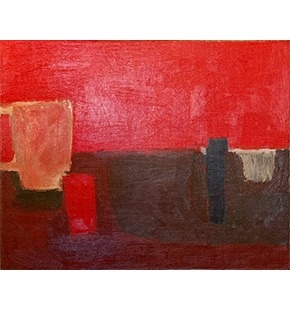
William Scott emerged as one of the defining figures of post-war British painting, renowned for his ability to unite abstraction with familiar domestic imagery. Born in Greenock, Scotland, and brought up in Northern Ireland, he studied at the Royal Academy Schools in London before the outbreak of the Second World War temporarily disrupted his artistic development. While his earliest works focused on still life and landscape, by the late 1940s he had arrived at the distilled visual language that would become his hallmark. Drawing together the influence of European modernism with a distinctly British restraint, Scott developed compositions marked by simplified forms, muted palettes, and a refined sensitivity to spatial balance. This quiet sophistication brought him international acclaim, culminating in his representation of Britain at the 1958 Venice Biennale. His paintings are now held in leading institutions such as the Tate, the Museum of Modern Art in New York, and the Art Institute of Chicago. Today, Scott’s work is widely recognised as central to the story of modern British abstraction. His gift for transforming humble domestic subjects — tables, pans, and vessels — into contemplative studies of shape, surface, and space continues to resonate with collectors and scholars alike. Supported by strong museum presence and enduring critical esteem, his paintings remain highly desirable in both British and international post-war art collections.
To enquire about one of our beautiful pieces simply fill out this form and a member of our team will be in touch with you. We can also answer queries about exhibitions, private viewings, restorations and more.
If there's a piece you're particularly interested in, we'd suggest taking advantage of our Artist's apartment for a complimentary one to two night stay while you visit the gallery and the historic surroundings.