Signed
Size (inches) : 28 (h) x 36 (w)
Size (cm) : 71.12 (h) x 91.44 (w)
Frame Size (inches) : 39 (h) x 47 (w)
Frame Size (cm) : 99.06 (h) x 119.38 (w)
View on background colour: Dark Graphite
string(6) "string"
string(2269) "
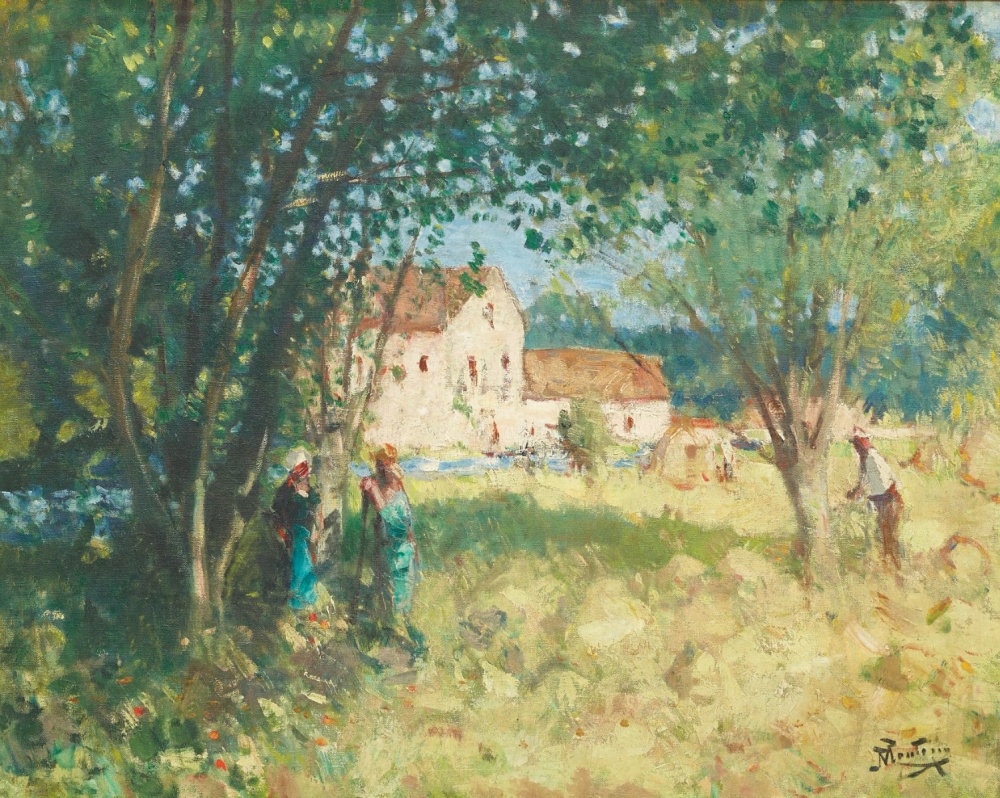
A Summer’s Afternoon is a warm, idyllic rural scene painted in Montezin’s signature late-Impressionist style. The composition is bathed in dappled sunlight, filtered through the leafy canopies of trees in the foreground.
On the left, two women dressed in deep blue/green garments and wearing white and red kerchiefs are seen conversing in the shade, their forms softened by Montezin’s loose brushwork. On the right, a man, partially obscured by a tree trunk, works in the sunlit field - perhaps cutting grass or gathering hay. The middle ground opens to a sun-washed farmhouse with pale cream walls and a warm red-tiled roof. It sits among patches of golden grass, haystacks, and splashes of greenery. The building’s bright tones contrast with the darker, cooler greens of the surrounding trees, enhancing the sense of depth.
Montezin’s brushwork is spontaneous and flickering, particularly in the foliage, where leaves are suggested through rapid, varied dabs of green, yellow, and blue. The light - a defining element of the piece, creates a dialogue between shadowed, cool-toned areas under the trees and the brilliant, sun-drenched expanses of the meadow.
The atmosphere is peaceful, evoking the slow rhythms of rural life during the height of summer.
Montezin exhibited regularly at the Salon des Artistes Français from 1903, winning numerous awards, and later became President of the Société Nationale des Beaux-Arts. His work often depicts pastoral French villages, gardens, and countryside, painted en plein air to capture the transient qualities of sunlight and weather.
A Summer’s Afternoon is an excellent example of Montezin’s mature style: Loose yet controlled brushwork to evoke shimmering light and movement. Strong contrasts between shade and sun, which give his rural scenes a tangible sense of temperature and time of day. Figures integrated into the landscape, not as focal points but as natural participants in the seasonal cycle of work and leisure. The painting aligns with the French tradition of plein air painting that began with the Barbizon school and blossomed through Impressionism, yet Montezin’s use of richer, warmer tones gives his work a slightly more romantic and nostalgic character.
"
A Summer’s Afternoon is a warm, idyllic rural scene painted in Montezin’s signature late-Impressionist style. The composition is bathed in dappled sunlight, filtered through the leafy canopies of trees in the foreground.
On the left, two women dressed in deep blue/green garments and wearing white and red kerchiefs are seen conversing in the shade, their forms softened by Montezin’s loose brushwork. On the right, a man, partially obscured by a tree trunk, works in the sunlit field - perhaps cutting grass or gathering hay. The middle ground opens to a sun-washed farmhouse with pale cream walls and a warm red-tiled roof. It sits among patches of golden grass, haystacks, and splashes of greenery. The building’s bright tones contrast with the darker, cooler greens of the surrounding trees, enhancing the sense of depth.
Montezin’s brushwork is spontaneous and flickering, particularly in the foliage, where leaves are suggested through rapid, varied dabs of green, yellow, and blue. The light - a defining element of the piece, creates a dialogue between shadowed, cool-toned areas under the trees and the brilliant, sun-drenched expanses of the meadow.
The atmosphere is peaceful, evoking the slow rhythms of rural life during the height of summer.
Montezin exhibited regularly at the Salon des Artistes Français from 1903, winning numerous awards, and later became President of the Société Nationale des Beaux-Arts. His work often depicts pastoral French villages, gardens, and countryside, painted en plein air to capture the transient qualities of sunlight and weather.
A Summer’s Afternoon is an excellent example of Montezin’s mature style: Loose yet controlled brushwork to evoke shimmering light and movement. Strong contrasts between shade and sun, which give his rural scenes a tangible sense of temperature and time of day. Figures integrated into the landscape, not as focal points but as natural participants in the seasonal cycle of work and leisure. The painting aligns with the French tradition of plein air painting that began with the Barbizon school and blossomed through Impressionism, yet Montezin’s use of richer, warmer tones gives his work a slightly more romantic and nostalgic character.