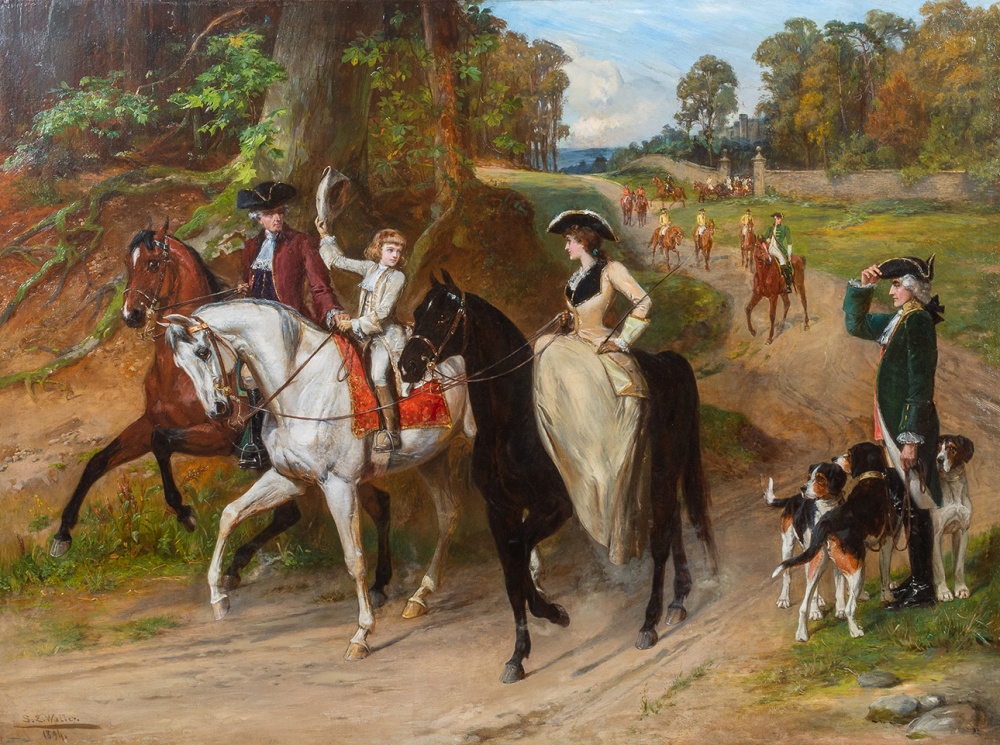
A Gallant Salute During an Afternoon Ride
Signed
Size (inches) : 36 (h) x 49 (w)
Size (cm) : 91.44 (h) x 124.46 (w)
Frame Size (inches) : 44.5 (h) x 57.5 (w)
Frame Size (cm) : 113.03 (h) x 146.05 (w)
View on background colour: Dark Graphite
A Gallant Salute During an Afternoon Ride
string(6) "string"
string(2047) "
A Gallant Salute During an Afternoon Ride captures a lively aristocratic equestrian scene infused with elegance and charm. In the foreground, a finely dressed gentleman on a white horse raises his hat in a courteous salute, accompanied by a young boy on horseback. Opposite him rides a lady in a sweeping cream gown and wide-brimmed hat, her posture refined and her gaze meeting his with poise.
To the right, a huntsman with a pack of eager hounds acknowledges the exchange, while further along the winding country path, a procession of mounted figures approaches, adding depth and narrative to the composition. The great oak tree anchoring the left side, the winding road, and the distant manor house framed by trees all enrich the sense of grandeur and setting.
Waller’s careful rendering of detail; the sheen of the horses, the folds of the costumes, and the animated expressions of the hounds, enhances the drama of the encounter, while his palette of earthy greens, browns, and soft sky tones situates the event in the warm light of the English countryside. Waller works in a highly naturalistic, Victorian narrative style, characterised by fine detail and a sense of theatrical staging. His mastery of equine anatomy, combined with the elegance of costume and gesture, creates a refined composition that blends portraiture with historical genre painting. The artist’s brushwork is smooth and polished, typical of late 19th-century academic realism, designed to capture the pageantry and romance of upper-class leisure pursuits. A Gallant Salute During an Afternoon Ride exemplifies Waller’s strength in creating vivid, theatrical narratives from genteel social rituals. Beyond the elegance of costume and setting, the painting conveys the ideals of courtesy, gallantry, and genteel romance—values much prized by Victorian audiences. The work not only reflects a fascination with earlier centuries of English aristocratic life but also embodies the Victorian nostalgia for a golden age of refinement and manners.
"
A Gallant Salute During an Afternoon Ride captures a lively aristocratic equestrian scene infused with elegance and charm. In the foreground, a finely dressed gentleman on a white horse raises his hat in a courteous salute, accompanied by a young boy on horseback. Opposite him rides a lady in a sweeping cream gown and wide-brimmed hat, her posture refined and her gaze meeting his with poise.
To the right, a huntsman with a pack of eager hounds acknowledges the exchange, while further along the winding country path, a procession of mounted figures approaches, adding depth and narrative to the composition. The great oak tree anchoring the left side, the winding road, and the distant manor house framed by trees all enrich the sense of grandeur and setting.
Waller’s careful rendering of detail; the sheen of the horses, the folds of the costumes, and the animated expressions of the hounds, enhances the drama of the encounter, while his palette of earthy greens, browns, and soft sky tones situates the event in the warm light of the English countryside. Waller works in a highly naturalistic, Victorian narrative style, characterised by fine detail and a sense of theatrical staging. His mastery of equine anatomy, combined with the elegance of costume and gesture, creates a refined composition that blends portraiture with historical genre painting. The artist’s brushwork is smooth and polished, typical of late 19th-century academic realism, designed to capture the pageantry and romance of upper-class leisure pursuits. A Gallant Salute During an Afternoon Ride exemplifies Waller’s strength in creating vivid, theatrical narratives from genteel social rituals. Beyond the elegance of costume and setting, the painting conveys the ideals of courtesy, gallantry, and genteel romance—values much prized by Victorian audiences. The work not only reflects a fascination with earlier centuries of English aristocratic life but also embodies the Victorian nostalgia for a golden age of refinement and manners.